
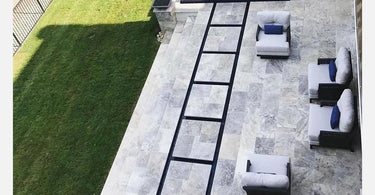
Quick answer: Yes, travertine paving works well in UK gardens when you choose an outdoor-grade stone, lay it properly and look after it. It is a natural limestone-family stone, so it should be sealed, cleaned with pH-neutral products and kept away from acidic cleaners such as vinegar or brick acid. If you want the travertine look with almost no maintenance, travertine-effect porcelain is the low-effort alternative.
Travertine has a warm, Mediterranean character that suits both period homes and contemporary gardens. It also raises more questions than most stones: will it survive a British winter, do the holes matter, and how do you clean it without damaging it? This guide answers those questions using what we see every day selling natural stone and porcelain paving.
What is travertine paving?
Travertine is a natural stone formed from mineral deposits around springs, which is why it has its typical pitted texture and soft, banded colour. Outdoors it is supplied as large sawn slabs, multi-size pattern sets and small tumbled setts. In our natural stone paving range you will find 20mm slabs such as Silver Travertine 600x900mm and Durango Travertine 600x900mm, both with a honed and filled finish, plus 30mm tumbled multi-size sets.
Is travertine frost resistant enough for a UK garden?
Good-quality travertine is widely used for outdoor paving in cold climates, and suppliers sell it for UK patios. Its long-term performance depends on two things: the quality of the stone and the quality of the installation. Water that collects in voids, under hollow spots or in failed joints is what causes trouble when it freezes, so a well-drained, fully bedded patio matters more than the stone name.
- Bed slabs on a full, even mortar bed rather than dabs, so there are no hollows for water to sit in.
- Build in a fall so rain runs off the surface instead of ponding.
- Keep joints in good condition and repair any that crack or wash out.
Our natural stone paving guide covers sub-base, fall and bedding step by step.
Filled, unfilled or tumbled: which travertine finish should you choose?
The finish changes the look, the feel underfoot and how much cleaning the stone needs.
| Finish | What it looks like | Good to know |
|---|---|---|
| Honed and filled | Flat, smooth surface; natural holes filled with resin or cementitious filler | Cleanest, most contemporary look. Smoother surfaces give less grip when wet, so test a sample with water before you choose. |
| Unfilled | Open natural pores on the surface | The most rustic texture; the open pores are where dirt and moss can settle, so expect more brushing. |
| Tumbled | Softened, rounded edges and an aged, worn look | Ideal for cottage and Mediterranean styles. Often sold in multi-size sets for random patterns. |
For example, the Silver Travertine multi-size set is a 30mm tumbled set made of four sizes, while the 600x900mm slabs are 20mm honed and filled.
Do you need to seal travertine paving?
Sealing is strongly recommended. Natural stone absorbs water and spills far more readily than porcelain, and a good impregnating sealer makes everyday stains and algae much easier to deal with. Our own travertine product pages advise sealing after installation and resealing periodically.
- Choose a sealer made for natural stone and follow its coverage and drying instructions.
- Seal in a dry spell. Sealing damp stone in cold, wet weather can leave a white bloom. If you are laying in late autumn or winter, follow the sealer manufacturer's guidance on timing and minimum temperature.
- Check it once a year. Sprinkle a few drops of water on the stone. If it beads, the sealer is working; if it darkens and soaks in, it is time to reseal. Cleaning will not bring a worn sealer back.
How do you clean travertine without damaging it?
The single most important rule: never use acid on travertine. Vinegar, lemon juice, brick and cement removers, rust removers and limescale removers can etch the surface and leave permanent dull patches.
- Sweep regularly and wash with a pH-neutral cleaner formulated for natural stone.
- Use a stiff brush, not a wire brush or abrasive pad.
- If you use a pressure washer, keep it on a low setting and hold the nozzle well away from the surface and joints.
- Read the label on any "end of build" cleaner. For example, DETERDEK PRO in our cleaning and maintenance range is a buffered acid cleaner for porcelain and acid-resistant stone, so it is not the right product for travertine.
Travertine vs travertine-effect porcelain: which is better?
If you love the look but not the upkeep, porcelain is worth comparing. Our Ephesus Silver 600x900x20mm, for instance, is an outdoor porcelain paver designed to reflect travertine.
| Travertine | Travertine-effect porcelain | |
|---|---|---|
| Look | Genuine stone, every slab different | Realistic travertine pattern, more consistent |
| Sealing | Recommended, with periodic resealing | Not needed for the slabs |
| Acid sensitivity | Etches with acidic cleaners | Resists acids and stains |
| Thickness in our range | 20mm slabs; 30mm tumbled sets | 20mm, rectified |
| Laying | Full mortar bed | Full mortar bed plus priming slurry |
For a wider comparison, read porcelain vs natural stone paving.
How much does travertine paving cost?
At the time of writing (16 November 2026), our Silver and Durango Travertine 600x900x20mm slabs are £65.98 per m², and the Silver and Durango multi-size sets are £989.99 per set, listed as covering 14.84m². Prices change, so always check the product page. Use the tile calculator to work out quantities and allow extra for cuts and colour blending.
Key takeaways
- Travertine suits UK patios when it is good quality, fully bedded and well drained.
- Honed and filled is smooth and modern; tumbled is rustic and forgiving.
- Seal it, check the sealer yearly with a water-drop test, and reseal when water soaks in.
- Clean only with pH-neutral stone products; never use vinegar or acid cleaners.
- Want the look with less care? Compare travertine-effect porcelain.
Frequently asked questions
Can travertine paving be used in the UK?
Yes. Good-quality outdoor travertine is used in cold climates, including UK gardens. Lay it on a full mortar bed with a fall for drainage, keep the joints sound and seal it, and it will cope with normal British weather.
Can I use vinegar to clean travertine?
No. Vinegar and other acids, including lemon juice, brick acid, cement removers and limescale removers, can etch travertine and leave permanent dull patches. Use a pH-neutral cleaner made for natural stone instead.
How often should travertine paving be sealed?
There is no fixed interval because it depends on the sealer, the finish and how much use the patio gets. Do a water-drop test once a year: if water soaks in and darkens the stone rather than beading, it is time to reseal.
Can you pressure wash travertine?
You can, but carefully. Use a low pressure setting, keep the nozzle well away from the surface and aim away from the joints. For routine cleaning, a stiff brush and a pH-neutral stone cleaner are usually enough.
What is the difference between filled and unfilled travertine?
Filled travertine has its natural holes filled with resin or a cementitious filler, giving a flatter, smoother surface that is easier to sweep. Unfilled travertine keeps its open pores for a more rustic look but collects more dirt and moss.
See travertine in your own garden light
Natural stone varies from batch to batch, so we always recommend seeing it first. Your first 3 samples are free, with free delivery. For advice on travertine or porcelain alternatives, call our Knutsford team on 01565 746144 or contact us online.
