
Last updated: 2 November 2026 · By the Tiles & Pavers team, Knutsford, Cheshire
Quick answer: For a flat or gently sloping UK garden, wood effect porcelain paving usually beats timber decking on upkeep and lifespan: it needs no oiling or staining, does not rot, and outdoor grades are typically slip-rated R11. Composite decking is closer in cost and durability, while decking on posts remains the easier option for steep slopes or raised areas. If you want the warm look of timber with the low maintenance of a patio, wood effect porcelain is the strongest all-rounder.
Autumn is when an old deck shows its weak points: green, slippery boards, soft spots and loose fixings. If you plan to replace yours next spring, this guide compares wood effect porcelain paving with softwood and composite decking.
What is wood effect porcelain paving?
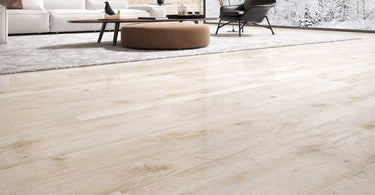
Wood effect porcelain is outdoor porcelain paving with a textured surface that recreates the grain and colour variation of timber. It absorbs very little water, will not rot and does not need sealing. Long plank formats such as 300x1200mm are laid in a board-style pattern that reads like decking.
Our outdoor porcelain paving for patios is 20mm thick, rectified and made to EN 14411. Our wood effect planks, such as Islay Maple 300x1200x20mm and Arno Natural 300x1200x20mm, are R11 slip-rated and designed for patios, paths and pool surrounds (not vehicle driveways). At the time of writing, most of the planks in the range start from £24.99 per m².
How does wood effect porcelain compare with decking?
Lifespan figures vary by product, installation and maintenance, so treat the table below as a typical guide rather than a guarantee.
| Factor | Wood effect porcelain paving | Softwood decking | Composite decking |
|---|---|---|---|
| Typical lifespan | Several decades with a sound base | Around 10–15 years | Around 20–30 years for quality boards |
| Routine maintenance | Sweep and wash; no sealing | Yearly cleaning plus oiling, staining or treating | Light washing |
| Rot and insects | Not affected | Vulnerable, especially the frame | Boards resist rot; frame still needs checking |
| Wet grip | R11 outdoor grades grip well when wet | Can become slippery with algae in shade | Textured boards generally grip well |
| Upfront cost | Mid; base preparation adds labour | Lowest, especially for DIY | Often similar to quality porcelain |
| Best ground | Flat or gently sloping | Slopes and raised areas | Slopes and raised areas |
Is wood effect porcelain less slippery than decking?
In most UK gardens, yes. Timber decking that sits in damp shade picks up a film of algae, which makes wet boards slippery, and this is one of the most common complaints from deck owners. Outdoor porcelain has a textured surface and, in our range, an R11 slip rating, which is the level usually recommended for patios that get wet. Keep it free of moss and algae to maintain grip. Our guide Is Porcelain Paving Slippery? R11 and Slip Ratings Explained covers ratings in more detail.
Which costs more over time: decking or porcelain?
Softwood decking is usually the cheapest to build, particularly as a DIY project. The gap narrows once you add the cost and time of cleaning and re-treating every year, replacing tired boards and eventually rebuilding the frame. Capped composite boards often cost a similar amount per square metre to quality porcelain paving, so the decision between those two tends to come down to your ground and the look you want rather than price.
The biggest variable for porcelain is groundwork: excavation, a compacted sub-base and a full mortar bed. On level ground that is routine; on a steep slope it can mean retaining walls and much more labour.
When is decking still the better choice?
- Steep or uneven gardens: a deck on posts can span a slope with little digging, whereas paving needs the ground levelled and retained.
- Raised seating areas: if you want a platform well above garden level, a framed deck is simpler. Note that in England, decking more than 30cm above the ground normally needs planning permission under permitted development rules, and extra limits apply to listed buildings and some protected areas, so check with your local planning authority.
- Short-term homes: decking is quicker to install and remove.
Can you replace old decking with porcelain paving?
Yes, and it is one of the most popular upgrades we see. Porcelain is never laid on top of timber boards: the deck and frame come out first. The usual steps are:
- Remove the boards, joists and any rotten posts, and check what is underneath.
- Excavate to the depth your installer needs for a compacted sub-base and mortar bed, keeping the finished patio below the damp proof course of the house.
- Plan a gentle fall away from the house so rainwater drains off the patio.
- Prime the back of each slab, lay on a full mortar bed and keep joints consistent.
- Point the joints with a suitable porcelain jointing compound once the bed has set.
Our installation guide walks through each stage. For raised installations over a suitable solid base, adjustable pedestals such as the Makofix Self-Levelling Adjustable Pedestal Set (55–90mm) can be an alternative to a mortar bed; ask us or your installer whether pedestals suit your project. If your new patio steps down to the lawn, our guide to building porcelain garden steps explains how to finish the edge with bullnose treads.
How do you get the most realistic decking look with porcelain?
- Choose long planks: 300x1200mm formats read most like boards.
- Lay them in one direction: run planks away from the house or across the widest view, just as you would with boards.
- Stagger the joints: a random or one-third offset looks more natural than a regular half-bond.
- Match the joint colour: a jointing colour close to the darkest tone of the plank keeps the eye on the grain rather than the gaps.
Use our tile calculator to work out how many planks you need, including an allowance for cuts.
Key takeaways
- Wood effect porcelain gives a timber look with no oiling, staining or rot, and typically outlasts softwood decking by many years.
- R11 outdoor porcelain usually grips better than wet, algae-covered timber.
- Composite decking is the closest rival on cost and upkeep; decking of any kind is easier on steep slopes and raised platforms.
- Replacing a deck means removing it completely and building a proper base for the new patio.
Frequently asked questions
Is wood effect porcelain paving cheaper than decking?
Not usually upfront: softwood decking is the cheapest option to build. Over the life of the patio, porcelain avoids yearly treatment and board replacement, and quality composite decking often costs a similar amount per square metre to porcelain.
Does wood effect porcelain look like real wood?
Modern wood effect porcelain recreates grain, knots and colour variation closely, especially in long 300x1200mm planks. Order free samples to see the texture and colour in your own light before you decide.
Is wood effect porcelain paving slippery when wet?
Our wood effect outdoor planks are R11 slip-rated, which is the level usually recommended for wet outdoor areas. Keep the surface free of moss and algae to maintain grip.
Can I lay porcelain paving over my existing decking?
No. Timber decking moves and rots, so it cannot support porcelain. Remove the deck and frame, then lay the porcelain on a properly prepared sub-base and mortar bed, or on pedestals over a suitable solid base.
Do I need planning permission to replace decking with a patio?
In England, raised decking more than 30cm above the ground normally needs planning permission. If your new patio changes ground levels, is in a front garden or is at a listed building, check with your local planning authority before you start.
Thinking of swapping your deck for a wood effect patio? Order up to three free samples with free delivery from our wood effect range, or call our Knutsford team on 01565 746144 for advice on quantities and installation.