
Last updated: 19 October 2026 · By the Tiles & Pavers team, Knutsford, Cheshire
Quick answer: Match the slab size to the size of the space and to how it will be laid. 600x600mm is the easiest to handle and cut and suits small gardens, paths and DIY projects; 600x900mm is a versatile all-rounder for medium patios; large formats such as 800x800mm and 600x1200mm give a sleek, open look with fewer joints, but they are heavier, need a flatter, better-prepared base and create more waste on awkward cuts. If in doubt, lay out a few samples or paper templates on the actual area before you order.
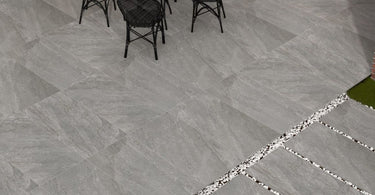
Autumn is when many homeowners start planning next year's patio, and slab size is one of the first decisions to make. It affects the look, how many cuts you will need, how much help you need on laying day and even how much you spend per square metre. Our outdoor porcelain paving is 20mm thick and rectified, and many designs come in several sizes – our Magma Grey range, for example, is available in 600x600mm, 600x900mm, 800x800mm and 600x1200mm – so you can choose the format without compromising on colour.
What counts as a large format paving slab?
There is no official definition, but in the UK paving trade "standard" generally refers to 600x600mm or 600x900mm, while "large format" (sometimes XL or XXL) is used for bigger slabs: 800x800mm, 600x1200mm, 1000x1000mm and long planks such as 300x1200mm. You will find these in our large format porcelain paving collection.
How do the common sizes compare?
Coverage below is calculated from the face size of each slab. Weights are approximate for 20mm porcelain and vary by product, so always check the specification of the slab you choose.
| Slab size | Area per slab | Slabs for 20m² (before wastage) | Handling | Typical use |
|---|---|---|---|---|
| 600x600mm | 0.36m² | 56 | Lightest of the four – manageable for one person | Small gardens, paths, stepping stones, DIY |
| 600x900mm | 0.54m² | 38 | Roughly 20–25kg – easier with two | Most family patios |
| 800x800mm | 0.64m² | 32 | Heavier and wide – a two-person lift | Medium to large modern patios |
| 600x1200mm | 0.72m² | 28 | Heaviest of the four – always a two-person lift | Large, open contemporary spaces |
Fewer slabs means fewer joints to fill, but each one takes more care to place.
What are the pros and cons of large format slabs?
Advantages
- Fewer joints: a cleaner, calmer surface that makes a big space feel even bigger.
- Contemporary look: ideal with modern architecture, bi-fold doors and an indoor–outdoor flow.
- Less jointing: fewer metres of joint to fill and keep clean.
Disadvantages
- Weight and handling: large slabs need two people and careful lifting to avoid chipped edges.
- Flatness matters more: any bump or dip in the sub-base shows across a long slab, and voids under it can lead to cracking, so a full, solid mortar bed is essential.
- More waste on cuts: curves, corners and irregular shapes leave bigger offcuts that are often too small to reuse.
- Scale: in a very small courtyard a handful of huge slabs can look out of proportion.
Which slab size suits my garden?
- Small courtyard or narrow side return: 600x600mm keeps the proportions right and reduces cutting. Two slabs side by side make a path about 1.2m wide.
- Typical family patio: 600x900mm is the safe all-rounder, laid in a stretcher or offset bond for a linear look.
- Large, open patio or a seamless link from a kitchen extension: 800x800mm or 600x1200mm for the fewest joints.
- Cottage or period property: a mixed-size pack such as our Magma Grey Mix-Size Patio Pack (30x60, 60x60 and 60x90cm pieces) gives a random, flagstone-style pattern.
Is large format paving harder to lay?
It is not a different method, but there is less room for error. Whatever the size, porcelain should go down on a well-compacted MOT Type 1 sub-base and a full mortar bed, with a porcelain priming slurry on the back of every slab and a fall so rainwater runs away from the house – our installation guide explains each step. With large formats:
- Spend extra time getting the sub-base flat and consistent.
- Make sure every slab is fully supported – no spot-bedding.
- Have two people for every lift.
- Check level along the long edges as you go; a tile levelling system can help keep neighbouring edges flush.
- Keep joints consistent – rectified porcelain is usually laid with narrow joints of around 3–5mm.
Does slab size change the cost?
It can. Within a single range the larger formats often cost more per m² – in our Magma Grey range, for example, the per-m² price rises from 600x600mm to 600x1200mm at the time of writing. On the other hand, fewer slabs can mean fewer joints and quicker placement, while large formats may need more preparation time. For a full budget picture, read how much a porcelain patio costs in the UK.
Key takeaways
- 600x600mm: easiest to handle and best for small spaces.
- 600x900mm: the versatile middle ground for most patios.
- 800x800mm and 600x1200mm: the cleanest look, but plan for two-person lifts and a very flat base.
- Order at least 10% extra for cuts and breakages – more for large formats or complex shapes.
Use our tile calculator to turn your measurements into slabs and packs, and see how to choose the best outdoor tiles for the other checks to make before you buy.
Frequently asked questions
What is the most popular paving slab size in the UK?
600x600mm and 600x900mm are the most widely used sizes for domestic patios because they balance appearance, handling and cutting. Larger formats are increasingly chosen for modern homes and big open spaces.
Do large paving slabs make a small garden look bigger?
Fewer joints can make a space feel calmer and larger, but in a very small courtyard oversized slabs can look out of scale and create a lot of cutting. Lay out paper templates first to see how the grid falls.
Can one person lay 600x1200mm porcelain paving?
It is not recommended. A 600x1200mm slab in 20mm porcelain is heavy and long, and should always be a two-person lift to protect both the installer and the slab edges.
How much extra paving should I order for large format slabs?
Allow at least 10% for cuts and breakages and more for large formats, curves or lots of corners, because offcuts from big slabs are often too small to reuse.
Can I mix different slab sizes on one patio?
Yes. Mixed-size patio packs are designed for this, and you can also combine a large format main area with smaller slabs for paths. Choose the same range and colour so the finish matches.
Not sure which size will work? Order up to 3 free samples with free delivery, or call our Knutsford team on 01565 746144 and we will talk you through the options. Landscapers and builders can also apply for a trade account.